
By Dr Lydia Altini MBBCh DipIBLM NBCHWC
“No western disease has been reported to be other than rare or uncommon in communities subsisting largely on foods rich in starch and fibre and low in fat, salt and sugar.” Dennis Burkitt, MD
As a medical student, I remember well a surgical consultant who drummed into us the value of a high fibre diet for the prevention of many of the diseases we were seeing on his ward rounds – from diverticulitis to haemorrhoids to colorectal cancer. We learnt about the rising incidence of diverticular disease for example, among urban South Africans who were replacing high fibre maize meal and whole meal bread with refined low fibre maize flour and white bread common to the Westernised diet.2 At the time there was also good evidence that a diet low in fibre was associated with type 2 diabetes.
Now, after decades of further research, the health benefits of dietary fibre are well recognised, not only because of their direct gastrointestinal effects, but also because of the profound impact fibre has on the gut microbiome.
What exactly is fibre?
Fibre, the undigestible component of carbohydrates, has traditionally been classified according to its solubility and viscosity, and fermentability.3 Most naturally occurring high fibre foods contain variable amounts of both soluble and insoluble fibres.
Soluble fibres are mostly fermented by gut bacteria resulting in the production of short-chain fatty acids (SCFAs) such as butyrate, acetate, and propionate. Viscous fibres like guar gum, certain pectin’s, beta-glucans and psyllium form a gel in the intestinal tract which delays the absorption of glucose and lipids.3, 4 Resistant starch is another component of soluble fibre, only found in starchy foods such as oats, rice, beans, potatoes and green bananas. Cooking destroys most resistant starches, but the resistant starch can be recaptured by allowing the food to cool down before eating.
Each fibre type supports different microbial species and metabolic pathways, with a diverse intake supporting a more resilient and functional microbiome. Polyphenols are metabolised by the gut microbiome into bioactive compounds that work with fibre to support gut function.3 This is why single-fibre supplements (e.g. psyllium or inulin), although helpful, cannot replicate the complexity of a plant-rich, diverse diet.
A lack of dietary fibre can shift microbial metabolism towards protein and mucin fermentation, increasing cytotoxic and pro-inflammatory metabolites.3 This was illustrated in the study by O’Keefe and colleagues comparing African Americans and rural South Africans, where a diet high in animal fat and protein was associated with higher carcinogenic secondary bile acids, while a high-fibre diet rich in resistant starch was associated with greater butyrate production. Remarkably, a 2-week food exchange produced reciprocal changes in biomarkers of colon cancer risk, highlighting how rapidly diet can influence microbial metabolism and colonic health.5
What are prebiotics?
Prebiotics are defined as substrates (mostly highly fermentable oligosaccharides) that confer a health benefit by selectively inducing beneficial bacterial populations in the gut, specifically Bifidobacterium and Lactobacillus spp. Some common food sources of prebiotics include unripe banana, barley, sorghum, millet, oats, peas, garlic, leeks, onions, asparagus, eggplant, legumes and cooked and cooled pasta, rice and potatoes.
The many health benefits of fibre:
- Improved laxation and bowel regularity – soluble fibres in particular, such as psyllium, can help prevent and manage constipation, though benefits depend on the underlying cause. (Oats, kiwifruit, prunes and legumes are also recommended.)
- Decreased LDL cholesterol.
- Improved post-meal glucose regulation – viscous fibres slow gastric emptying and carbohydrate absorption, thereby reducing post-prandial glucose spikes.
- Increased satiety, appetite regulation and reduced energy absorption supporting weight control.
- Binding and increased excretion of bile acids, oestrogen and certain toxins, such as heavy metals.
- Production of SCFAs that:
- Provide energy for the cells lining the colon (especially butyrate).
- Stimulate mucus production and secretion supporting gut barrier integrity and decreasing susceptibility to infections.
- Suppress chronic inflammation both in the bowel and systemically.
- Acidify the colon increasing mineral solubility and absorption.
- Modulate or have a positive stimulating effect on the immune system.3
Overall studies show that a high fibre intake is associated with a decreased risk of 7:
- Coronary heart disease
- Type 2 diabetes
- Colorectal and breast cancer
- Hypertension
- Depression and anxiety
- Inflammatory Bowel Disease
- Risk of death from all causes
How much fibre do I need?
Current recommendations for dietary fibre intake are 25–30 g/day, although evidence suggests benefits continue to increase at intakes approaching 40 g/day or more. This is substantially higher than the 14–18 g/day typically consumed in Western diets.6,7
A deficiency of fibre is probably the most widespread nutrient deficiency in those eating a typical Western Diet. No upper level of intake is set as a diet high in fibre will not produce substantial adverse effects when part of a healthy diet.
Increasing fibre too quickly without enough fluid can cause intestinal discomfort and may worsen constipation. Gradual increases tend to work better, with tolerance increasing over time as the microbiota adapt.3
Practical ways to increase your fibre intake:
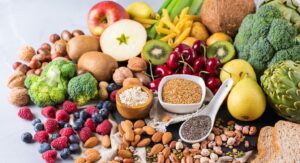
Foods highest in fibre include raspberries and pears, green peas and broccoli, barley, oats, bran flakes, quinoa, split peas, lentils, black beans, chia seeds, nuts and seeds.8
I begin my day with a high fibre breakfast which always has as its base oats with berries. A serving of each will give me close to 10g of fibre in total. I add various fibre boosters such as:
1 tablespoon of chia seeds (5.4g fibre)
1 heaped tablespoon of ground flaxseeds (6.5g fibre)
1 tablespoon of hempseeds (1.4g fibre)
2 teaspoons of raw cacao (2.4g fibre)
These few additions bring the total amount of fibre in my breakfast bowl to close to 26g. Along with legumes, wholegrains, fruit and vegetables consumed at lunch and dinner, one can easily achieve 40g or more.
Here are a few other practical ways to increase your fibre intake:
- Incorporate fresh, whole fruit and vegetables into every meal and snack.
- Choose whole grain rice, breads and pastas over refined products.
- Get creative and add beans or legumes into soups and stews instead of, or together with, animal protein.
- Swap juices for smoothies. The fibre lost through juicing will be blended into the smoothie.
The evidence is clear that dietary fibre plays a central role in human health and is consistently associated with improved gastrointestinal function, reduced risk of cardiovascular disease, type 2 diabetes, colorectal disease and premature mortality. Despite this, most people fall well short of recommended intakes. By gradually increasing both the quantity and diversity of fibre from whole plant foods, such as vegetables, fruits, legumes, whole grains, nuts and seeds, we can take a simple, practical step toward better health, one meal at a time.
References:
- Burkitt DP. (1983) Eradicating sources or removing results. Postgrad Med J. 59(690):232-235. doi:10.1136/pgmj.59.690.232
- Trowell, H. C., & Burkitt, D. P. (1979). Diverticular disease in urban Kenyans. British medical journal, 1(6180), 1795. https://doi.org/10.1136/bmj.1.6180.1795-a
- Makki, K., Deehan, E. C., Walter, J., & Bäckhed, F. (2018). The Impact of Dietary Fiber on Gut Microbiota in Host Health and Disease. Cell host & microbe, 23(6), 705–715. https://doi.org/10.1016/j.chom.2018.05.
- Pugh, J. E., & Chambers, E. S. (2025). Dietary fibre and the gut microbiome: implications for glucose homeostasis. Current opinion in clinical nutrition and metabolic care, 28(6), 483–488. https://doi.org/10.1097/MCO.0000000000001160
- O’Keefe, S. J., Li, J. V., Lahti, L., Ou, J., Carbonero, F., Mohammed, K., Posma, J. M., Kinross, J., Wahl, E., Ruder, E., Vipperla, K., Naidoo, V., Mtshali, L., Tims, S., Puylaert, P. G., DeLany, J., Krasinskas, A., Benefiel, A. C., Kaseb, H. O., Newton, K., … Zoetendal, E. G. (2015). Fat, fibre and cancer risk in African Americans and rural Africans. Nature communications, 6, 6342. https://doi.org/10.1038/ncomms7342
- Carbohydrate intake for adults and children: WHO guideline [Internet]. Geneva: World Health Organization; 2023. Recommendations and supporting information.Available from: https://www.ncbi.nlm.nih.gov/books/NBK594788/
- Reynolds, A., Mann, J., Cummings, J., Winter, N., Mete, E., & Te Morenga, L. (2019). Carbohydrate quality and human health: a series of systematic reviews and meta-analyses. Lancet (London, England), 393(10170), 434–445. https://doi.org/10.1016/S0140-6736(18)31809-9
- Mayo Clinic (Dec 24, 2025). Chart of high-fiber foods[online] Mayo Clinic. Available at: https://www.mayoclinic.org/healthy-lifestyle/nutrition-and-healthy-eating/in-depth/high-fiber-foods/art-20050948.